
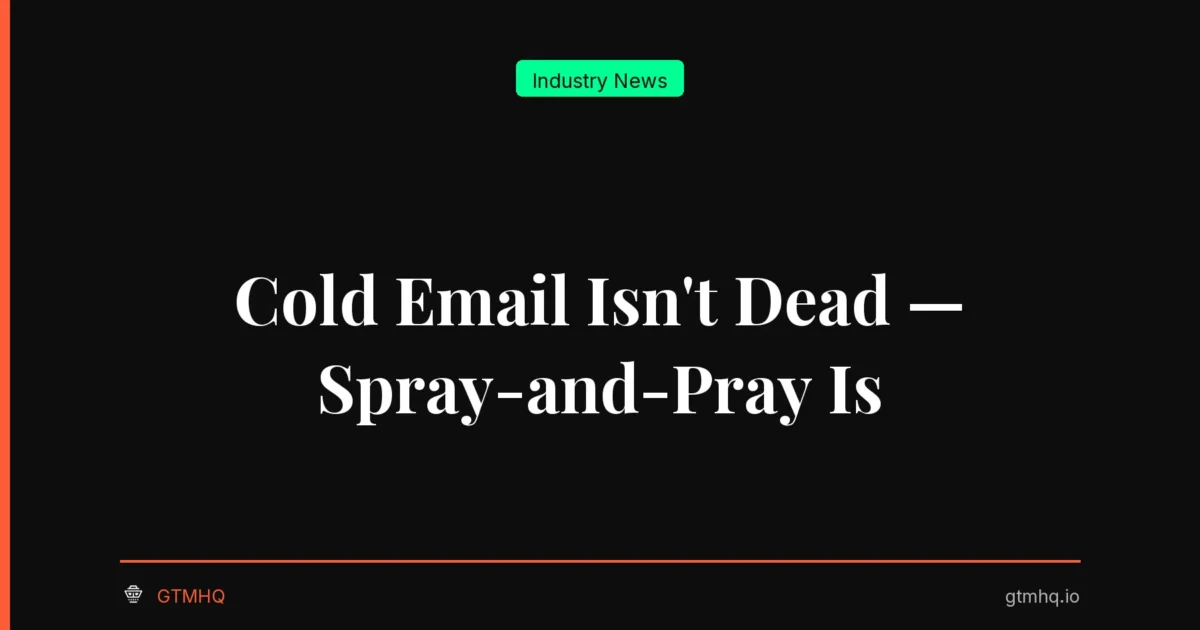
The average cold email gets a 3.43% reply rate. That sounds terrible — and for most senders, it is. But buried in the same Instantly.ai 2026 Benchmark Report covering more than 100 million emails is a second number: signal-based campaigns average 15–25% reply rates. That is a 5x performance gap between teams doing the exact same thing — sending cold email. The difference is not the tool, the subject line, or the send time. It is targeting discipline. Cold email is not dead. Spray-and-pray is. Here is what the data shows and what you should do instead.
Why Cold Email Is Dead Goes Viral Every Year
It is a reliable Q1 ritual. A marketer posts a hot take — cold email is dead — it gets hundreds of reshares from people who tried it, got ignored, and want validation. The claim feels true because most people’s experience with cold email is genuinely terrible. And their experience is terrible because they are spray-and-praying.
Spray-and-pray is the practice of building the largest list possible, writing one generic message with a first-name merge tag, blasting it at scale, and hoping volume compensates for weak targeting. It does not.
- 160 billion spam emails are sent globally every day
- Gmail’s spam complaint threshold is 0.1% — exceed it once and your domain is throttled for months
- 17% of cold emails never reach any inbox at all
- 95% of cold emails receive no reply
When practitioners say cold email is dead, what they have actually experienced is that spray-and-pray stopped working. It did. But cold email — targeted, signal-triggered, short — is not only alive, it is generating some of the strongest pipeline numbers in B2B sales right now.
What the 2026 Benchmark Data Actually Shows
The Instantly.ai 2026 Benchmark Report analyzed over 100 million cold emails. The headline average — 3.43% reply rate — is accurate. So is this: the top quartile of senders consistently achieves 5.5%+, the elite tier averages 10.7%, and signal-based campaigns reach 15–25%. The variable driving that gap is not copy quality. It is campaign precision.
| Campaign Type | Average Reply Rate |
|---|---|
| 500+ recipient blast | 2.1% |
| Under 50 recipients (targeted list) | 5.8% |
| Signal-based outreach | 15–25% |
Campaigns sent to fewer than 50 tightly qualified contacts average 5.8% reply rates versus 2.1% for blasts over 500. More volume does not fix weak targeting. It amplifies it.
There is also a compounding deliverability cost rarely discussed. Sending 10,000 generic emails does not just waste your time this week — it poisons your sending domain for months. Spam complaints compound. Sender reputation is slow to rebuild. The true cost of a spray-and-pray campaign is not the time spent sending it. It is the pipeline you cannot build afterward because your domain is damaged.
The Signal Hierarchy: What Replaced Spray-and-Pray
Signal-based outreach means reaching a prospect because something real happened in their world that makes your message immediately relevant. Not because they match your ICP firmographics — because something changed.
The strongest signals, ranked by reply rate according to Autobound’s 2026 cold email research:
| Signal Type | Reply Rate Range |
|---|---|
| Leadership change (new C-suite or VP hire) | 14–25% |
| Funding round announced | 12–20% |
| Hiring surge in target department | 10–18% |
| Earnings call mention (public companies) | 10–15% |
| Technology stack change | 8–15% |
A new VP of Sales at a target account is actively evaluating their entire tech stack, vendor relationships, and team structure. They have no legacy loyalty. They are looking for quick wins to establish credibility. Your message — sent within the first 30 days of their tenure — lands in a completely different context than a generic cold email sent six months into a quiet period.
There is also a new version of spray-and-pray worth watching: AI tools have made it cheaper than ever to generate personalized-looking emails at scale. GPT-powered sequences with dynamic company snippets produce high-volume outreach that looks personalized but is not triggered by real signals. AI-assisted spray-and-pray is the 2026 version of the same problem. Volume with no signal still averages 2.1%.
Three Changes to Make This Week
If your reply rates are sitting at 2–4%, the fix is not a new subject line. It is a smaller, better-triggered list.
- Cut your list size. Fewer, higher-fit contacts outperform volume every time the data is measured. Build lists of 30–50 contacts per signal type before scaling.
- Stack signals before outreach. Leadership change + hiring surge + recent funding round means a prospect is actively making decisions. Reach them then, not in month three of their quiet period.
- Send under 80 words. The Instantly benchmark data shows elite performers averaging under 80 words per email. Long emails reduce reply rates and damage deliverability simultaneously.
Cold email is a precision instrument. Teams using it as a firehose are generating the 3.43% average that fuels the dead narrative every year. Teams using it as a precision tool are building pipeline at 15–25% reply rates. The method is not dead. The mindset is.
Ready to build the signal-led system? Start with the signal-led outbound playbook and ensure your email infrastructure is set up to support precision sending.
Frequently Asked Questions
Is cold email still effective in 2026?
Yes. Signal-based cold email campaigns average 15–25% reply rates in 2026 according to Instantly.ai benchmark data covering 100M+ emails. The channel is effective; spray-and-pray volume tactics are not. Precision targeting consistently outperforms mass outreach by 5x.
What is the average cold email reply rate in 2026?
The platform-wide average is 3.43% (Instantly.ai, 100M+ emails). Top-quartile senders hit 5.5%+, elite senders average 10.7%, and signal-based campaigns reach 15–25%. The wide range is explained entirely by targeting quality, not email copy.
What signals should trigger cold email outreach?
The highest-converting signals are leadership changes (14–25% reply rate), funding rounds (12–20%), hiring surges in the target department (10–18%), earnings call mentions (10–15%), and technology stack changes (8–15%). Stack two or more signals for the strongest response rates.