
On March 11, 2026, Clay announced the most significant pricing update in the company’s history—a restructuring clay new pricing that reduces data costs by 50-90%, consolidates plans from three to two self-serve tiers, and fundamentally changes how GTM teams pay for data enrichment and orchestration. For a platform that crossed $100M ARR in 2025 and powers GTM operations at OpenAI, HubSpot, and thousands of other companies, this is a signal moment for the GTM tools market.
The question for revenue leaders isn’t just whether Clay got cheaper. It’s how this pricing shift reflects broader changes in GTM operations—where data costs are plummeting, orchestration value is being separated from data margins, and AI pricing models are becoming more transparent. Here’s what GTM teams need to understand about Clay’s new pricing.
The Headline Changes
Clay’s pricing update has four core components that reshape the value proposition:
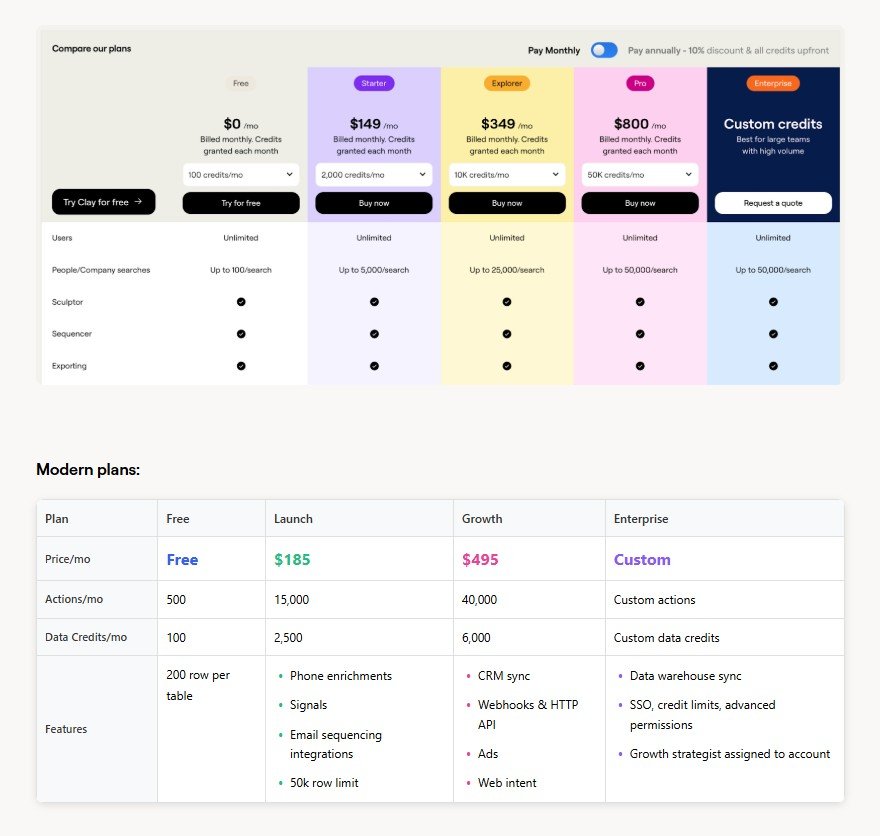
- New plan structure: Launch ($185/mo), Growth ($495/mo), and Enterprise (custom) replace Starter, Explorer, and Pro
- Data cost reduction: 50-90% lower data costs in Clay’s marketplace through direct volume negotiations with 150+ data partners
- Pricing transparency: Data Credits (data costs) separated from Actions (platform orchestration)
- AI pricing flexibility: 80% of AI models remain flat-rate; token-intensive models now priced at true cost with zero markup
The net effect: Growth plan customers get CRM integrations, Web Intent, and Clay’s new Ads product for $495/mo—$305 less than the old Pro plan, with more features included.
New Plan Structure: Launch, Growth, Enterprise
Clay consolidated three self-serve plans (Starter, Explorer, Pro) into two, each designed around specific GTM use cases:
Free Plan: Low-Risk Experimentation
The Free tier remains unchanged as an on-ramp for teams learning Clay. Unlimited seats and tables, multi-provider waterfalls, Claygent enrichment, Clay Sequencer for email, and up to 200 rows per table. Comes with 100 Data Credits and 500 Actions per month. This is the try-before-you-buy tier for individual contributors evaluating whether Clay fits their workflow.
Launch Plan ($185/mo): Individual and Small Team Automation
Launch replaces Starter as the entry-level paid plan, but with meaningful upgrades. Includes everything in Free, plus phone number enrichment, job change and signal tracking, email campaign integrations, and up to 50,000 rows per table. Comes with 2,500 Data Credits and 15,000 Actions per month. Launch customers typically target up to 1,000 accounts with Clay.
This is the plan for individual GTM engineers or small teams running their first automated prospecting workflows. The phone enrichment addition is significant—it’s historically been one of Clay’s most expensive data types, now accessible at the entry-level tier.
Growth Plan ($495/mo): Scaling GTM Motions
Growth is where Clay concentrated its most valuable features. This plan now includes CRM auto-sync and enrichment, HTTP API integrations, webhook automation, web intent signal tracking, audience pushes to ad platforms, and priority support. Comes with 6,000 Data Credits and 40,000 Actions per month. Growth customers typically target between 1,000 and 20,000 accounts.
The $305 price reduction from the old Pro plan ($800/mo) is notable. But the more important change is feature consolidation—CRM integrations and Web Intent, previously scattered across plans, are now bundled into Growth. HTTP API also moved from Explorer to Growth, reflecting Clay’s view that API usage is a marker of advanced GTM teams.
Enterprise: Custom with Annual Commitment
Enterprise remains custom-pricing with annual commitment, but the feature set has expanded. Includes everything in Growth, plus unlimited Audiences across sources, unlimited row bulk enrichment, Clay API access, data warehouse syncs, SSO, RBAC permissions management, additional Ads audiences, and a dedicated Growth Strategist. Includes 100,000+ Data Credits and 200,000+ Actions per month. Enterprise customers typically target more than 20,000 accounts.
The Data Credit Revolution: 50-90% Cost Reduction
The most economically significant change is Clay’s decision to reduce data costs in its marketplace by 50-90%. Data Credits are used when purchasing data from Clay’s 150+ data partners—finding emails, phone numbers, company data, enrichment fields, and more.
Under the old model, Data Credits were more expensive, and costs scaled predictably with usage. Under the new model, Clay negotiated volume discounts directly with data partners and passed those savings entirely to customers. The result: Data Credits start at $0.05 each and become cheaper as you grow.
Why This Matters for GTM Teams
For high-volume outbound teams, data costs are often the largest line item in the GTM tech stack. A team enriching 50,000 records per month with phone numbers and email addresses might have spent $2,000-$3,000 monthly on data alone under Clay’s old pricing. Under the new model, that same workflow could cost $400-$1,200—a 60-80% reduction.
This changes the economics of outbound. Lower data costs mean better ROI on enrichment-heavy workflows, more aggressive TAM coverage, and more room for experimentation with data providers.
Data Credits vs Actions: New Transparency
Clay’s previous pricing bundled platform costs and data margins together. The new pricing separates them explicitly:
- Data Credits: Pay for the data itself—the email address, phone number, or company detail sourced from Clay’s 150+ data partners. Clay passes through volume-negotiated pricing with zero markup.
- Actions: Pay for Clay’s orchestration work—routing requests, calling providers, running workflows, syncing results. Actions cost less than $0.01 each and get cheaper with scale.
This separation is meaningful because it lets GTM teams see exactly what they’re paying for. Data-heavy workflows now have transparent, competitive pricing. Platform-heavy workflows can bring their own API keys and skip Data Credit costs entirely.
If an Enrichment Returns No Result, You Pay Nothing
Clay’s new pricing includes an important guarantee: if an enrichment returns no result, you’re not charged Data Credits or Actions. This eliminates a major pain point in legacy enrichment models, where teams paid for failed lookups. Under Clay’s new model, you only pay for value received.
AI Pricing: 80% Flat-Rate, 20% Variable
AI is central to modern GTM workflows, and Clay’s new pricing acknowledges that different AI use cases have different cost structures. The company split AI pricing into two categories:
Fixed-Price AI: 80% of Models
The majority of AI models in Clay—including all of Clay’s native models—continue to cost a flat number of Data Credits per task. These are ideal for common tasks like classification, short summaries, templated content generation, and simple lookups. Flat-rate pricing means predictable costs for routine AI workloads.
Variable AI: Token-Intensive Models at True Cost
Token-intensive models like GPT-5.1 and Claude 4.6 Sonnet now have variable pricing based on actual token consumption. These models are best suited for multi-step research, complex Claygent prompts that synthesize across multiple sources, and detailed account-level analysis. Clay charges customers exactly for the tokens consumed with zero markup.
This is a transparent pricing model—frontier AI at true cost, rather than padded with margin. For GTM teams running research-heavy Claygent workflows, this means costs that scale with actual usage rather than flat over-provisioning.
Under the new model, Clay reports that 85% of customers using AI will spend less. The company also notes that AI runs are 2x faster using Clay’s API keys compared to customers using their own, thanks to higher rate limits negotiated with AI vendors.
The Plan Consolidation Logic
Clay’s decision to consolidate from three self-serve plans (Starter, Explorer, Pro) to two (Launch, Growth) wasn’t arbitrary. The company analyzed customer behavior and found that most Explorer plan customers would migrate to either Starter or Pro within their first year—Explorer wasn’t meeting customer needs.
The new structure consolidates the most valuable features—CRM integrations, Web Intent, Ads—into Growth as a premium offering. This reflects Clay’s view that advanced GTM teams need these features together, not à la carte.
Migration Timeline
New pricing takes effect March 11, 2026. For existing customers:
- Self-serve customers (Starter, Explorer, Pro): Stay on current plan by default. Clay will proactively reach out if new pricing offers better value based on usage. Customers can switch to modern plans (Launch or Growth) at any time, or change legacy plans until April 10, 2026.
- Enterprise customers: Contracts remain in place and transition to new pricing at renewal. Dedicated Growth Strategists will proactively reach out if teams can save money, model out the impact, and guide transition planning.
- Trial users: Users who began trials before March 11 can choose between legacy and modern plans through their trial duration. New trial users select from modern plans.
What This Means for the GTM Tools Market
Clay’s pricing update isn’t just a pricing change—it’s a statement about where the GTM tools market is heading:
Data Commoditization Accelerates
By reducing data costs 50-90% and passing through volume-negotiated pricing with zero markup, Clay is signaling that data enrichment is becoming a commodity. The value in GTM tools is shifting from data access to orchestration, workflow design, and AI integration. GTM teams should expect other players to follow Clay’s lead on data pricing.
Transparency as Competitive Advantage
Separating Data Credits from Actions makes pricing transparent. GTM teams can see exactly what they’re paying for data vs platform. This contrasts with legacy tools that bundle margins into opaque per-record pricing. Expect transparency to become a baseline expectation.
AI Pricing at True Cost
Clay’s decision to price frontier AI models at true cost with zero markup is notable. It reflects a reality where AI vendors are competing on price, and GTM tools can’t pad AI costs without losing customers to direct API usage. Expect more tools to adopt pass-through AI pricing.
Practical Takeaways for GTM Teams
For Current Clay Customers
If you’re on Starter, Explorer, or Pro, wait for Clay’s proactive outreach. The company has your usage data and will recommend whether migration saves money. If you’re heavy on CRM integrations or Web Intent, the Growth plan likely offers better value. If you’re primarily doing basic prospecting, Launch may suffice.
For Teams Evaluating Clay
The new pricing makes Clay more competitive for data-heavy workflows. If you’re doing high-volume phone or email enrichment, the 50-90% cost reduction is material. If you’re bringing your own API keys for data providers, Clay’s Actions-only pricing for orchestration is now more transparent.
For Enterprise Teams
The expanded Enterprise feature set—unlimited Audiences, unlimited row bulk enrichment, data warehouse syncs—makes Clay more viable for large-scale GTM operations. The addition of dedicated Growth Strategists for Enterprise customers is also significant; it’s Clay betting that high-touch customer success drives retention at scale.
Conclusion
Clay’s pricing update is more than a price cut—it’s a restructuring that reflects how GTM operations have changed. Data is cheaper, orchestration is more valuable, and AI pricing should be transparent. For GTM teams, the question isn’t whether Clay is cheaper. It’s whether this pricing model reflects a broader shift in how GTM tools should be priced: data at cost, orchestration at value, and AI at true cost.
The companies that win in GTM over the next decade will be the ones that build on commoditized data, orchestrate it effectively, and use AI transparently. Clay’s new pricing is a bet that this future is already here.